

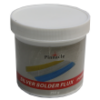
The Bronze Brazing Flux is a high-performance, active chemical compound specifically engineered for the South African agricultural, automotive, and general engineering sectors. Formulated as a versatile "universal" flux, this 500g powder is the primary choice for joining mild steel, galvanized iron, copper, and cast iron using brass or bronze filler rods. It acts as a powerful cleaning agent that dissolves surface oxides at high temperatures, ensuring a deep metallurgical bond and preventing the "porosity" often found in poorly fluxed structural repairs.
Key Performance Features
- High-Temperature Oxide Dissolution: Specifically active at the elevated temperatures required for bronze-welding, breaking down stubborn oxides on steel and cast iron.
- Enhanced Capillary Action: Dramatically reduces the surface tension of the molten bronze or brass filler rod, allowing it to "tin" the base metal surface smoothly and evenly.
- Porosity-Free Chemistry: Formulated to prevent gas entrapment in the cooling weld pool, resulting in high-integrity joints that can withstand mechanical stress.
- Broad Base-Metal Compatibility: An essential "all-rounder" for the workshop, effective on everything from thin-walled tubing to heavy-duty cast iron pump housings.
Ideal Applications
- Agricultural Equipment Repair: The "go-to" flux for brazing cracked cast iron components, such as gearbox housings and engine manifolds, on vintage and modern tractors.
- Bicycle & Light Frame Fabrication: Perfect for "fillet brazing" high-tensile steel tubing where a smooth, strong, and aesthetic joint is required.
- HVAC & Industrial Piping: Used for joining heavy-gauge copper and brass fittings in commercial plumbing and industrial refrigeration systems.
- General Workshop Maintenance: Ideal for hard-facing applications and repairing galvanized gates or fencing where standard welding might compromise the zinc coating.
Product Benefits
- Cost-Effective 500g Bulk Tub: Supplied in a durable, moisture-resistant container that is sized for high-volume fabrication shops and busy maintenance departments.
- Simple "Hot-Dip" Application: The most common method involves heating the end of the brazing rod and dipping it into the powder; the flux adheres to the rod and melts into the joint during heating.
- Reduced Post-Weld Grinding: Produces a clean, fluid bead that requires minimal finishing, saving significant time during the preparation for painting or powder coating.
Pro Tip: For the best results on cast iron, "ve-out" the crack and clean it until the metal is bright. Heat the base metal to a dull red before applying the fluxed rod. The flux should turn liquid and clear just before the bronze starts to flow. If the bronze "balls up," the metal is either too cold or requires more flux to break the surface tension.
Related products

Hand & Power Tools and Accessories


Hand & Power Tools and Accessories
Hand & Power Tools and Accessories