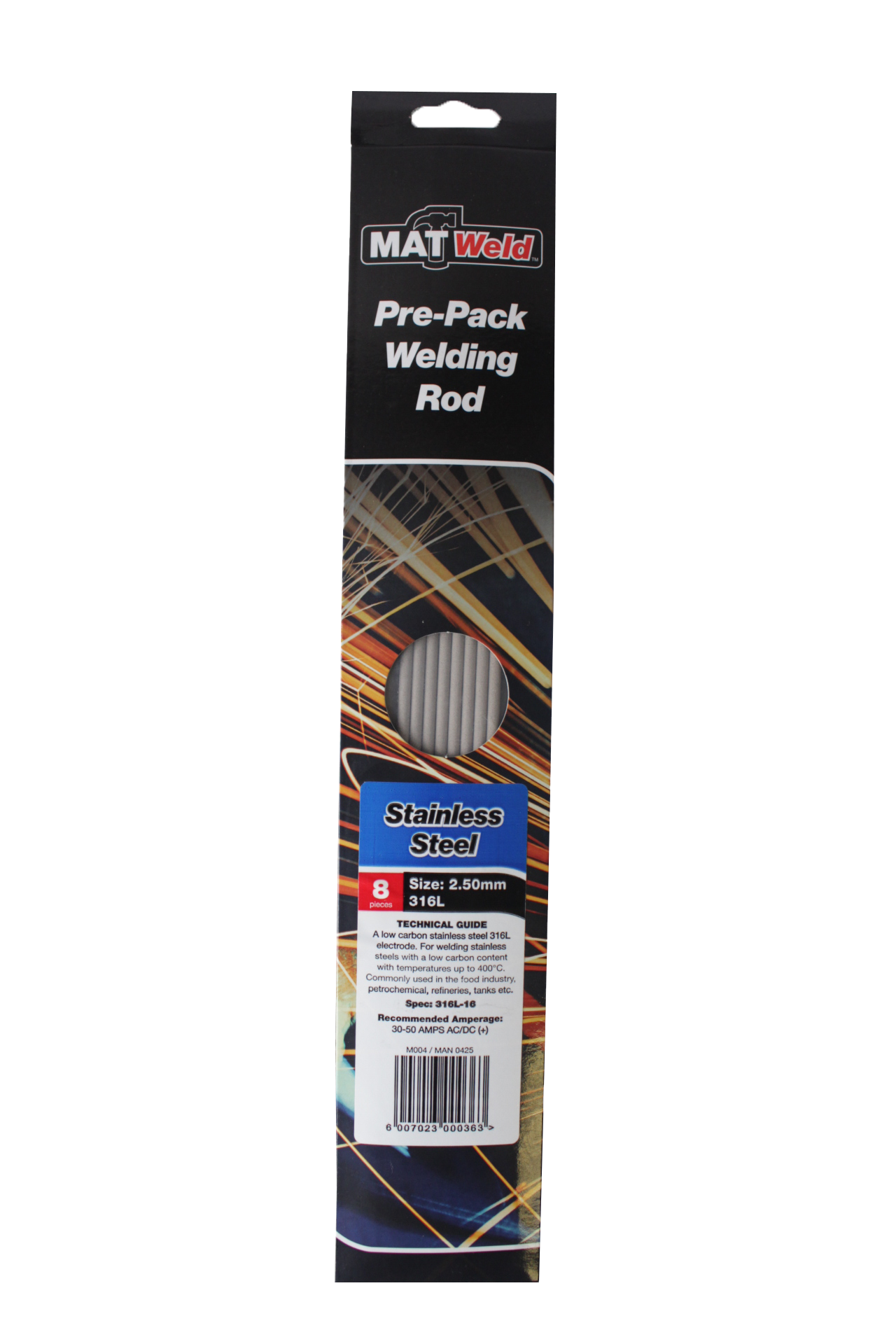

The Matweld M004 is a high-quality, rutile-basic coated stainless steel electrode designed for the shielded metal arc welding (SMAW/Stick) of common stainless steel grades. Specifically formulated as an E308L-16 type, it is the industry standard for joining 300-series alloys, providing a weld deposit that is highly resistant to corrosion and heat.
Technical Specifications
- Electrode Diameter: 2.5mm.
- Classification: AWS A5.4 E308L-16.
- "L" Designation: Denotes Low Carbon (max 0.04%), which reduces the risk of intergranular corrosion (carbide precipitation) during welding.
- Current Type: AC or DC+ (Electrode Positive).
- Amperage Range: 50A – 80A (Recommended for 2.5mm).
- Tensile Strength: 520 MPa
- Elongation: 35
Key Features
- Smooth Arc Transfer: The rutile coating ensures a very stable arc with minimal spatter, resulting in a finely rippled, professional-looking weld bead.
- Self-Releasing Slag: Under correct settings, the slag often lifts off by itself as the weld cools, significantly reducing cleaning time and the risk of slag inclusions.
- Moisture Resistance: The coating is designed to resist moisture pick-up, though keeping them dry is still essential for X-ray quality welds.
- All-Position Welding: Suitable for flat, horizontal, vertical-up, and overhead positions.
- Heat Resistance: The weld metal maintains its integrity and oxidation resistance at service temperatures up to 350°C.
Common Applications
- Food & Beverage: Welding stainless steel piping, tanks, and catering equipment (Grade 304/304L).
- Architectural: Fencing, balustrades, and decorative stainless steel fixtures.
- Chemical Industry: Maintenance of pumps, valves, and agitators handling mildly corrosive fluids.
- General Fabrication: Joining stainless steel to itself or to other 300-series alloys (except for Mo-stabilized grades like 316)
Usage & Maintenance Tips
- Preparation: Stainless steel is sensitive to contamination. Use a dedicated stainless steel wire brush (never one previously used on mild steel) to clean the joint. Even tiny particles of mild steel can cause "tea staining" or rust on the finished stainless weld.
- Heat Management: Stainless steel has lower thermal conductivity and a higher expansion rate than mild steel. To prevent warping, use "tack welds" more frequently and allow the workpiece to cool between passes.
- Short Arc Technique: Maintain a very short arc length. A long arc can lead to alloy loss and increased porosity in the weld pool.
- Storage: Store in a cool, dry place. If the electrodes have been exposed to high humidity, re-dry them in an electrode oven at 250°C – 300°C for one hour before use to ensure the best mechanical properties.
- Post-Weld Cleaning: For maximum corrosion resistance in food-grade or marine environments, use a pickling paste after welding to remove the "heat tint" (oxidation) from the heat-affected zone.
Related products

Hand & Power Tools and Accessories
Price range: R154.91 through R199.90 Incl